
- Integration of multiple protection functions into one compact housing
- User-friendly HMI
- Compact design due to SMD technique
- Measurement & Protection
- DO Matrix Programmability
- Last 5 fault records (non-volatile memory)
- Under / Overpower Protection in the forward direction
- Reverse Power Protection
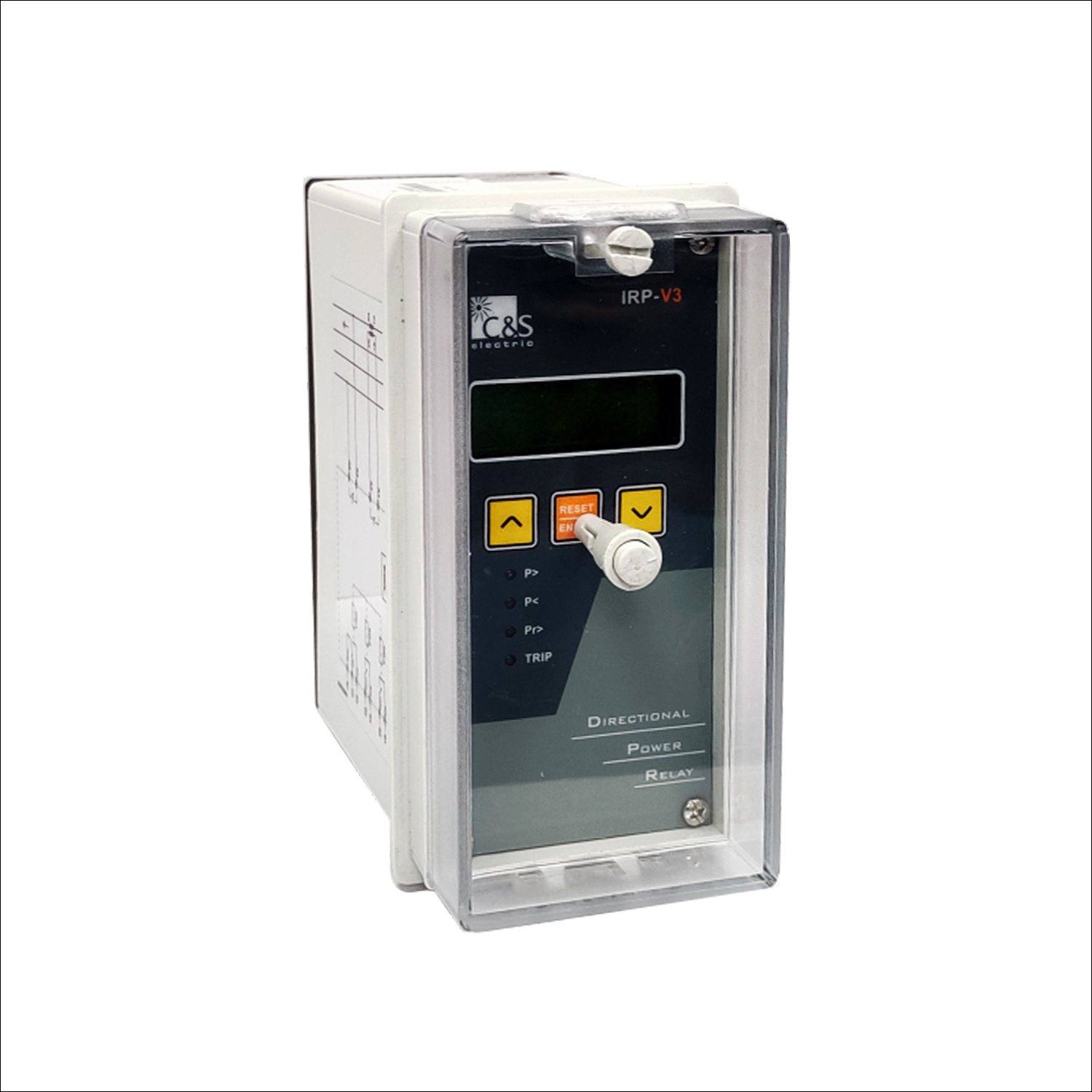
Directional Power Relay: IRP-V3
FEATURES
The directional power relay IRP is used for reverse power or forward active power supervision in low-voltage and medium-voltage systems. The load is measured in one phase only on the assumption that the phases are loaded symmetrically.
Among other applications, the relay can be used as a directional power relay for protection against reverse power or forward power of Turbo generators and Diesel generating sets if the prime mover fails. The IRP recognises the power direction and switches off the alternator. This way, power losses and damages to the prime mover are avoided.
The C&S Electric IRP-V3 Directional Power Relay offers benefits centred on specialised protection for generators and distribution networks by detecting the direction of power flow, preventing equipment damage and improving system stability.
- IRP-V3 is safeguarding generators operating in parallel with the mains or other generators. It detects this “reverse power” condition and trips the alternator off the system, preventing damage.
- It provides forward or reverse active power supervision in low and medium-voltage systems.
- It includes a separate adjustable trip delay, phase shifting adjustment, and a wide operating range for the auxiliary supply voltage (AC/DC).
- It uses static protection relay technology with a compact design and is available in plug-in technology with self-shorting CT circuits for easy maintenance and installation.
- The relay reliably meets all relevant IEC/DIN regulations required for individual applications, ensuring a high standard of safety and performance.
- The numerical display provides information on setting values, actual measured and memorised fault data, aiding in monitoring and troubleshooting.