
- 3-Phase High-Impedance Protection: Dedicated 3-phase differential current supervision with an adjustable pickup value
- In-built Inrush Blocking: Prevents nuisance tripping and maintains stable operation during energization.
- True RMS Measurement: Utilizes a Discrete Fourier Transform (DFT) filter for accurate signal measurement.
- Programmable Outputs: Equipped with 3 digital output (DO) relays with programmable assignments and configurable reset modes (Auto/Manual).
- Integrated Fault Recording: Non-volatile memory stores the last 5 fault logs.
- Human-Machine Interface (HMI):
- Bright 12×2 character LCD display.
- 3 front panel push buttons for setup, navigation, and manual reset.
- 5 LED indicators for status.
- Communication & Software Support: Front USB Type-A interface for connection to a PC using proprietary software to configure settings, view measurements, and export or print fault records.
- Wide Auxiliary Power Supply: Supports universal operating ranges of 18–300V DC / 60–280V AC.
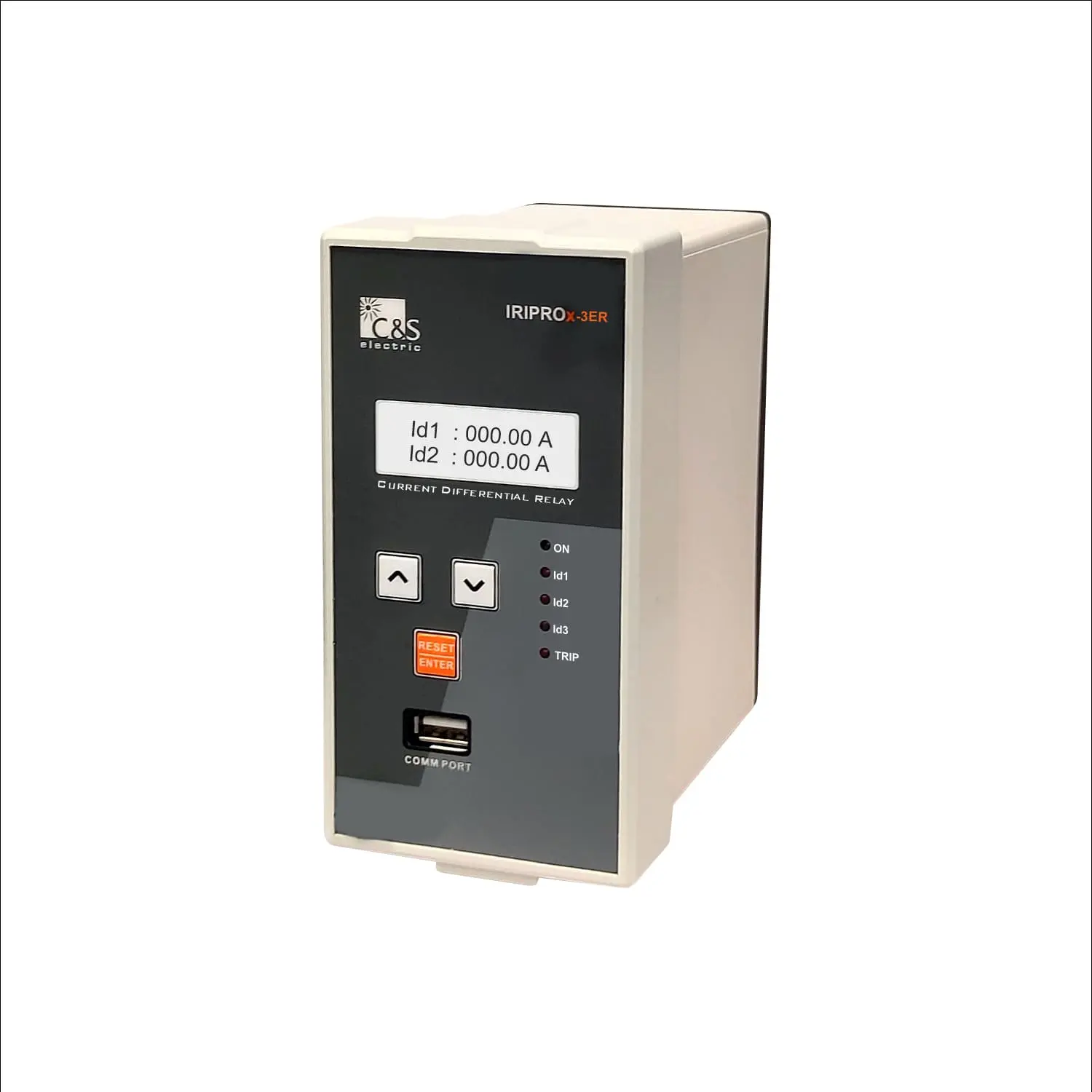
Advance 1-Phase & 3-Phase Current Differential Protection Relay
FEATURES
The IRIPROx-1ER-3ER is a numeric, compact 3-phase high-impedance current differential protective relay. Part of the IRIPro series, it provides reliable and fast protection along with monitoring and programmable digital outputs in a single unit.
APPLICATION:
The IRIPROx-3ER relay is specifically designed for the high-impedance differential protection and monitoring of: Generators, Transformers
- Fast and Stable Tripping: When a dangerous internal fault occurs, the relay reacts nearly instantly initiating a shutdown sequence.
- High External Fault Stability: If a fault happens outside its protected zone (external fault), the relay intelligently remains stable, ensuring it does not cause unnecessary power shutdowns.
- No Lost Data: Because the fault history is stored in non-volatile memory, your fault records remain safely saved even if the control panel completely loses auxiliary power.
- Easy PC Diagnostics: Includes a plug-and-play front USB port. Maintenance teams can easily plug in a standard USB cable to a laptop to change settings, view past faults, or print out diagnostic records.