
- Detection of high impedance earth faults with a low frequency test voltage.
- Short circuit and overvoltage-proof measuring input for the earth fault protection
- Exciter current measurement galvanically isolated, measuring range 0-20A
- Display of insulation resistance and of the excitation current
- Excitation current over & undercurrent protection with independent settings for current and delay time
- Detection of diode failures by supervision of the ripple component of the excitation current
- Two-stage supervision of the rotor insulation resistance with independent settings for resistance and time delay
- Digital inputs for blocking and for remote reset
- Programmable function of the blocking input
- Programmable assignment of protective functions to output relays
- Remote interfacing via RS-485 (optional)
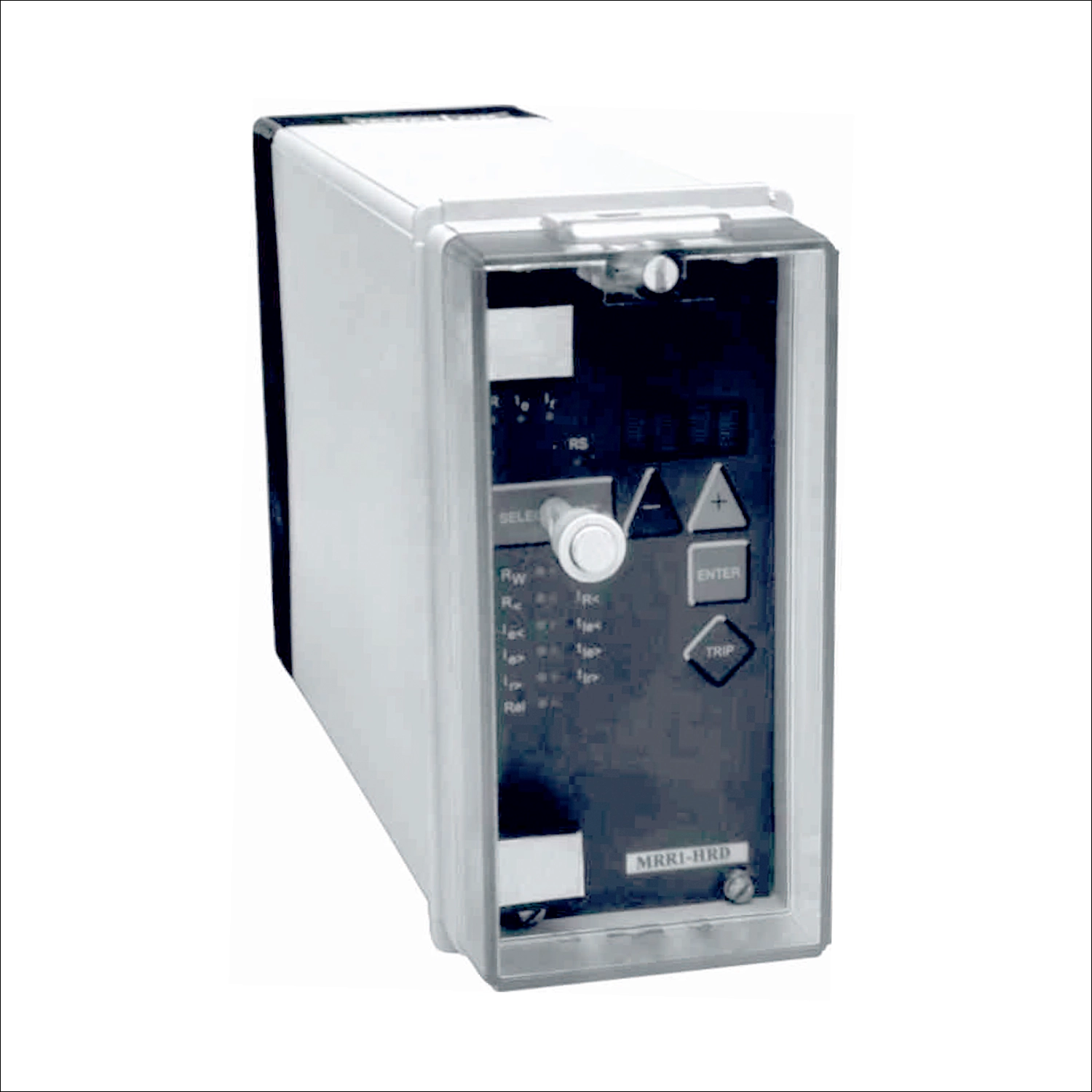
Generator Rotor Protection Relay: MRR1
FEATURES
The generator rotor protection relay MRR1 combines rotor earth fault protection, excitation over- and under-current protection. Thus providing a powerful protection regarding the rotor of synchronous generators.
- DC undercurrent relay
- Field relay
- Rectification failure relay
- Ground detector relay
- DC overcurrent relay
The rotor earth fault element detects high- and low-resistance earth faults of the rotor winding. It is equipped with two stages, one for alarm, one for trip. The protective functions are: Undercurrent, overcurrent and ripple detection for diode failure protection. Because of the combination of three protective functions in one device, the MRN2 is a very compact mains de-coupling device.
Multifunction Generator Rotor Protection Relay MRR1 provides comprehensive protection by integrating multiple functions into one device, which enhances system reliability, reduces downtime, and simplifies maintenance.
- Combination of several crucial protections in a single compact unit (MRR1 combines rotor earth fault, excitation over/undercurrent, and rotating diode failure protection).
- The relay prevents severe damage to the generator by detecting and isolating faults and abnormal conditions quickly (such as voltage fluctuations, overloads, and earth faults), thereby extending its operational life.
- The relay’s fast and selective tripping action ensures only the faulty section is isolated, minimising disruption to the rest of the system and enabling quick fault isolation.
- The device stores detailed information about fault events with date and time stamps, and may include disturbance recording.
- Integrating multiple functions into one device reduces the need for separate relays, saving panel space and potentially lowering installation and inventory costs.
- Modern C&S relays often include communication ports and other monitoring systems, allowing for remote operation and control.