
- Overload, Short Circuit, Under Current, Unbalance, Phase Loss, Phase Reversal, Stall, Locked Rotor, Earth Fault (Residual/CBCT), Over Temperature, External Fault
- Three Phase RMS current, Thermal content (%), Unbalance current (%)
- In-built real-time clock available. Fault gets registered with date and time to identify the time/date of failure.
- Last 5 Fault/Failure records to identify the history of failure
- Accumulated Trip Counter
- Max Starting Current
- Last 3 START/STOP records
- Accumulation of motor operating hours to analyse motor service factors like bearing check, refuelling cycling etc.
- In-built fail-safe operation feature available for trip contact
- Programmable Automatic/Manual/Remote reset functions available for different schemes.
- Thermal overload protection with different trip classes.
- External PTC thermistor interface available to monitor & protect motor bearing, winding from overheating
- MODBUS RTU over RS-485
- 4-20mA output for PLC
- Digital input & Digital output programmability
- All parameter settings are protected via password protection to avoid unauthorised access
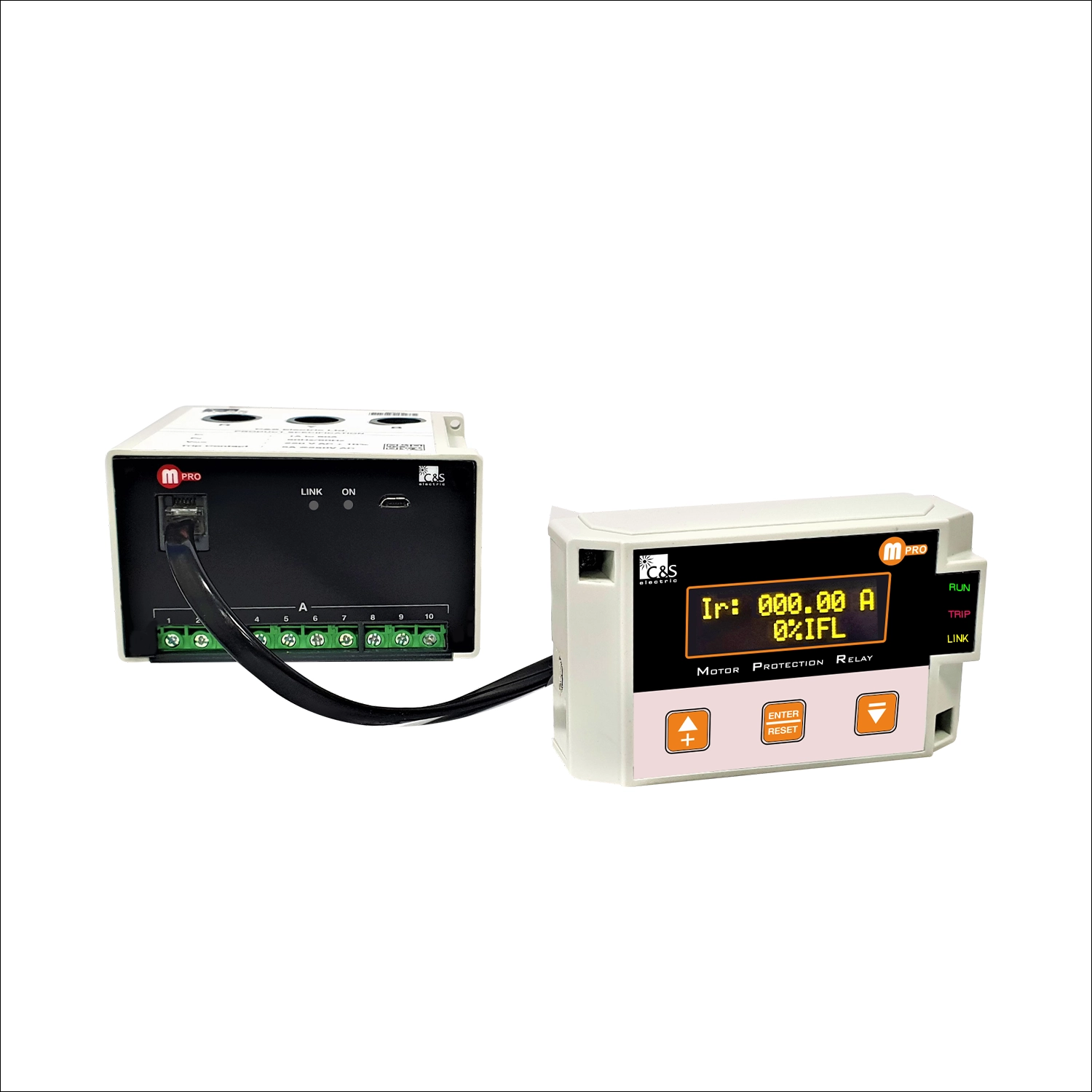
Advanced Current-Based Numeric Relay - mPRO-200
FEATURES
The mPRO-200 protective relay is an advanced current-based numeric relay that provides multi-protection and monitoring in a compact DIN-rail enclosure. The relay offers reliable protection for LV and MV motors, which are either operated via power contactors or power circuit breakers.
mPRO-200 comprises of DIN Rail mountable Base Module and a Panel mountable Display Module.
mPRO-200 offers the following features in a compact, modular & smart design.
The C&S mPRO-200 relay provides comprehensive motor protection by monitoring current and other parameters to guard against issues like overload, phase loss, and phase reversal. Its key features include protection from thermal overload, protection during start-up (locking of the rotor) and operating conditions, and diagnostic capabilities such as fault recording and communication via MODBUS RS-485 or an analogue output.