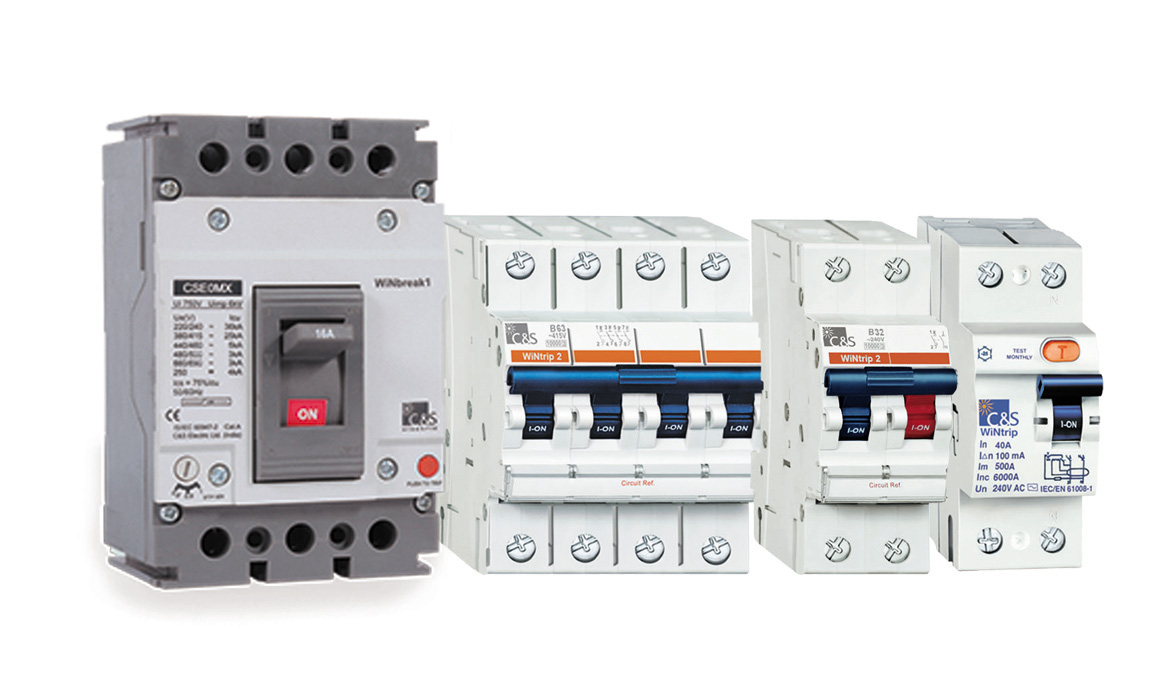
In the modern world, electricity is the backbone of our daily lives. It powers our work, our entertainment, and our essential home and factories functions. However, this must be carefully managed. At every residential and commercial electrical system lies a small but mighty device: the Miniature Circuit Breaker (MCB).
While most people only think about their breaker panel when the lights go out, let us understand how these devices work for home safety. This guide explores what MCBs are, how to find issues, and how to maintain the healthy electrical environment.
What is MCB and Why it is important?
MCB is an electromagnetic device designed to protect an electrical circuit or electrical conductor from damage caused by high fault current. Not like the old fuses used in the mid-20th century, which get melted and requires replacement after a every fault, MCB can be “reset” and used repeatedly.
Its main job is to detect 2 specific types of problems:
- Overload: When you load too many devices into one circuit, that draws more current than the wires can safely handle.
- Short Circuit: When a “live” wire touches a “neutral” wire, causing an instantaneous surge.
Without an MCB, these conditions can cause wires to overheat, melt their insulation, and starts the fire inside circuit.
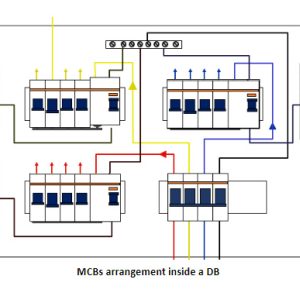
MCBs arrangement inside a DB
According to the type of curve/applications the MCB is of 3 types:
- B Curve: This type of MCB has a lower short circuit trip zone and can be used for Resistive/ Lighting loads, for example, lights, heaters, etc.
- C Curve: These MCBs have a higher short circuit tripping zone and can be useful for the inductive type/motor loads, for ex: AC, Refrigerator etc.
- D Curve: These MCBs have a very high short circuit tripping zone and are generally used for the loads which draw a very high starting current such as Sodium Lamps.
How Do I Know if a Circuit Breaker is Tripped?
When a room suddenly goes dark or a device stops working, the first thing you should check is your fuse box. But how to find the right MCB from the row of identical switches?
- Toggle Position
- ON (Up): The circuit is closed and power is flowing through the circuit.
- OFF (Down): The circuit is manually disconnected.
- TRIPPED: When a fault occurs, the internal mechanism operates the switch to OFF position. It will feel “springy” or loose when touched, not like the click of the ON or OFF positions.
- Visual IndicatorsMCBs have a small “status indicator”
- Green indicates the circuit is safe
- Red or Orange indicates a fault or that the breaker has tripped.
- The “Halfway” TrapOne of the most common points of confusion is a breaker that looks “ON” but is tripped. Sometimes, the lever only moves a fraction of an inch. If you are not sure, tap the levers; the tripped one will usually wobble, while the active MCB will feel rigid.
How Do You Reset a Tripped Circuit Breaker?
Resetting a breaker is a simple task but doing it wrong can harm the conductor or devices
Step 1: Reduce the Load
Before you touch the panel, go to the room or device that lost power. Turn off or remove the plug of the last device you turned on. If the trip was caused by an overload, try to reset the breaker while the other load is still connected it will just cause it to trip again immediately.
Step 2: The “Full Off”
This is the step many people miss. You cannot simply reset a tripped breaker back to the “ON” position.
- Push the lever securely down to the OFF position until you feel a solid click.
- Wait a second or two.
Step 3: Back to “ON Position”
Now, again push the lever up to the ON position. If the power stays on, you have successfully reset the circuit.
Warning: If the breaker trips again immediately stop. This suggests a “severe fault” or a short circuit.
The “Ground Fault”
One of the reasons a breaker may trip is a Ground Fault. To understand this, you must understand where electricity wants to go. Electricity always chooses the path with least resistance to Earth (the ground).
A ground fault occurs when the “live” wire—the wire with active current—accidentally touches a grounded part of the system. This could be:
- The metal housing of an appliance
- A copper water pipe.
- The literal ground wire (usually green or bare copper).
Why is it dangerous?
If you touch an appliance that is having a ground fault, your body might become the easiest path to the ground. This results an electric shock.
How to spot it:
Ground faults are caused by moisture. If a breaker trips specifically when it rains, or when you use a power tool outdoors, a ground fault is the likely occur. In many modern homes, these are handled by RCCBs or RCBOs, which are more sensitive than MCBs and trips in milliseconds to save live.
How to Avoid MCBs Tripping
Prevention is always better than a trip. Most tripping incidents are preventable with a few changes in habits and regular maintenance.
- Map Your CircuitsDo you know which device is on which breaker? Most people don’t know until a trip event occurs. Take a lamp plug into various outlets and operate the breakers ON/OFF to check the controls. Label your panel clearly. For example, that your microwave and your refrigerator are on the same 15-amp circuit—a recipe for frequent trips.
- The Rule of High-Wattage AppliancesKitchens and laundry rooms are “trip zones” because they house appliances that generate heat. space heaters, toasters, and kettles use high amount of current.
- Avoid the “Multi-Plug”: Never plug two high-wattage device into the same socket.
- Inspect Your TechA common cause of “unknown trips” is not the house wiring; it can be a faulty device.
- Check for damaged cords or darkened marks on plugs.
- If a specific device trips the breaker every time you turn it on, the issue is the device, not the MCB.
- Professional MaintenanceEvery few years, hire an electrician to check the torque on your panel. Over time, the vibrations of electricity and the contraction caused by heat can loosen the screws and wires into the MCB. A loose wire creates resistance, resistance creates heat, and heat causes the MCB to trip.
Conclusion
The MCB is your home or factories silent guardian. By knowing how to identify a trip, how to reset it safely, and how to prevent overloads and ground faults, you are protecting your family and your property from electrical hazards.
Keep your load balanced, your cables in good condition, and never ignore a breaker that keeps “talking” to you by tripping.
Frequently Asked Questions
MCBs have more advantages as compared to Fuse because they are resettable and reusable, whereas the fuses must be replaced every time after they faces fault. They operate much faster and more precisely for fault detection, which can better protect sensitive electronics from damage. MCBs provide a clear visual indicator to show if a circuit has tripped or not, which makes them safer and more user-friendly.
We can perform a basic manual test by toggling the switch “ON” and “OFF” many times to confirms the mechanical movement is smooth and firm. For a functional test, so many specialized units have a “Test” button that simulates a fault to ensure the internal mechanism trips correctly. For a professional verification, an electrician uses a multi-meter or a “loop tester” to confirm the circuit’s resistance and tripping time is in safe limits
The “best” type depends for which device you are using for: Type B is best for general home use (lights and fans) because it is the most sensitive. Type C is for appliances with small motors, like air conditioners or washing machines, as it handles medium level power surges. Type D is reserved for heavy-duty industrial equipment, like X-ray machines or large motors, which require a high initial surge to start.
No, an MCB is a factory-sealed device and cannot be repaired if the internal components fail. If the casing is cracked, the switch feels loose, or it fails to stay “ON” after a fault is cleared, it must be replaced with a new MCB. If you open or fix an MCB, it is extremely dangerous and can lead to failure to trip during a fault
Technically we can use the MCB to manually turn a circuit on or off, it is not recommended for daily use like a standard light switch. MCBs are designed as safety devices for fault protection; their internal mechanical springs can wear out if toggled hundreds of times in a month. Regular manual switching can make the breaker weak, causing it to fail when a real electrical fault occurs.