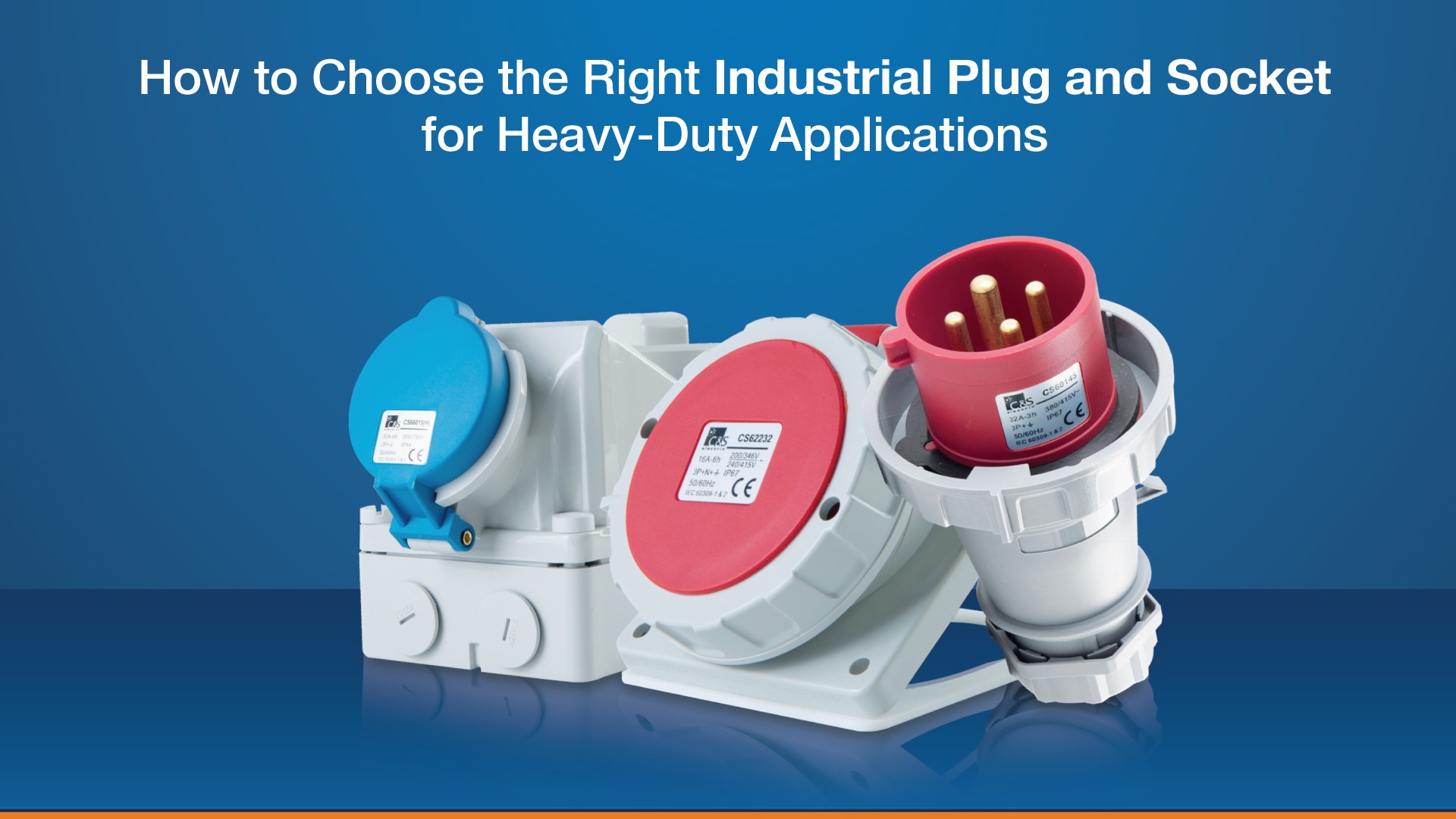
A Guide to Industrial Plugs and Sockets
In this world of heavy industry, power is not about turning on a switch; it is about reliability, safety, and durability. While a standard household plug might handle your toaster, it would literally melt under the demands of a factory floor or a construction site.
Choosing the right industrial plug and socket is the difference between a seamless operation and a catastrophic electrical failure. This guide helps you to understand about selection of the right plug and socket for applications.
Industrial vs. Standard: What’s the Real Difference?
The most common mistake is assumption that “a plug is a plug.” In reality, industrial connectors are manufactured for completely different environments than the domestic.
- Build Quality: Standard and normal plugs use thin plastic and brass. Industrial versions use high-impact, UV-resistant polymers and heavy-duty alloys.
- Connection Mechanism: Industrial sockets often feature a “twist type lock” or a locking ring to prevent accidental or wrong connection—a vital feature when heavy machinery is vibrating nearby.
- Colour Coding: not like domestic plugs, industrial plugs are colour-coded by voltage (e.g., yellow for 110V, blue for 230V, red for 400V) to prevent wrong connection
Right Current and Voltage Ratings
For heavy-duty applications, getting the ratings right is not just a suggestion—it’s a safety requirement.
Understanding Voltage
Voltage is standardized by colour to ensure you never plug a 110V connector into a 400V socket.
- Yellow (100–130V): Common on construction sites for power tools.
- Blue (200–250V): Standard single-phase industrial power.
- Red (380–480V): Three-phase power used for heavy machinery and large motors.
Understanding Amperage (Current)
- Current ratings confirm how much “flow of current ” the connector can handle without getting overheat. Common industrial ratings include 16A, 32A, 63A, and 125A.
- Always calculate your peak load. If your machinery draws 30A during start time, a 32A socket is the bare minimum, but a 63A provides a safer “headroom” to prevent heat.
IP Ratings for Harsh Environments
If you are working in a “harsh environment” like mines, chemical plants, or docks—the Ingress Protection (IP) rating is the must require thing. This two-digit code tells you how well the device resists solids particles (first digit) and liquids (second digit).
Which IP Rating do you need?
- IP44 (Splash-proof): it is Suitable for indoor industrial use where there is less dust or light water splashes.
- IP67 (Watertight): The higher rating for harsh environments. These can be submerged in water up to 1 meter and are completely dust proof. If your site is facing high-pressure water jet or heavy rain, the IP67 is very suitable.
Standards and Compliance for Industrial Plug and sockets.
Heavy-duty electrical equipment’s must comply with the international standards to ensure interchangeability and safety.
- IEC 60309: This is the international standard for “plugs, socket, and couplers for industrial use.” If your equipment does not mention IEC 60309, That could be dangerous.
- CE/UL Marking: It depends on your region; these certifications make sure that the product has undergone fire and impact testing.
Are they safe for outdoor/high-load use?
Yes—if they are “rated or selected” correctly. An industrial plug is designed to extinguish “arcing” (sparks) that occurs when disconnecting under load. Many heavy-duty sockets also feature an interlock switch, which prevents the plug from being pulled out at the time of live connection.
Factor |
What to check |
|---|---|
| Environmental conditions | The connector is exposed to chemicals, UV rays, or water? (Choose IP67 for these conditions). |
| Load Type | Is it a constant load or a motor with high inrush current? |
| Pin Configuration | Do you need 2P+E (Single Phase), 3P+E (Three Phase), or 3P+N+E? |
| Mounting | Do you need a wall-mounted socket, a panel-mounted one, or a trailing coupler? |
Application of Industrial Plug and Sockets:
- Manufacturing: For providing power to heavy machinery like CNC machines, lathes, and assembly lines that require stable Three-Phase power supply
- Construction: Provides temporary power for cranes, hoists, and tools.
- Marine & Offshore: Widely used on docks and oil rigs for ship-to-shore power. This type of application requires IP67 ratings to face saltwater and storms.
- Food & Chemical Plants: Used where equipment or storage container is frequently washed with high-pressure water jets or exposed to chemicals.
- Events & Entertainment: For providing power to stage lights, sound systems, and generators for outdoor concerts and festivals.
- Transport: Powering Refrigerated Containers (Reefers) at ports and on ships to keep goods cold
Maintenance: The Safety Factor
Even the IP67 socket will fail if it is not maintained properly.
- Check for Pins: Look at the pins. If they look charred or pitted, it’s a sign of arcing. Replace it immediately.
- Gasket: In watertight sockets, the rubber seal will keep the water out. If it is cracked, your IP67 rating will fail.
- Terminals: Vibrations from industrial machinery or motors can loosen the wire screws inside the plug over time, that builds heat inside the contacts
CONCLUSION
Choosing the right industrial plug and socket is not just about supplying power to the machine for turn on and off, it is about protecting your equipment, your facility, and your people. We should choose the connector that comply IEC 60309 standards and which also matches the color-coding of voltage, and when in doubt, also verify IP rating
Frequently Asked Questions
To make the right choice, you must first check for the power requirement of your machine, specifically voltage and current. Next, check where it will be used; if it is a wet or dusty area, you should go with a higher IP protection level. You also have to match the number of poles with your electrical system, like 3-pin for single-phase or 5-pin for three-phase. Finally, make sure the plug and socket size physical matches so they can lock together safely.
For harsh environments, you should consider an IP67 or a higher rating, which make sure that the connection is completely dust-tight and waterproof. If the area only faces the splashes, an IP44 rating can also keep it safe. In very extreme industrial environment with high-pressure cleaning, you might even see IP69K
Heavy-duty industrial plugs start from 16A and go up to 125A or more for large machinery. The voltage level is color-coded for safety: yellow is for 110V, blue is for 230V, and red is for 400V (three-phase). You must choose a rating that is equal to or slightly higher than your equipment rating to prevent overheating.
Yes, industrial plugs and sockets are designed to work safer in outdoor environment as compared to standard home plugs. They are made from tough plastics that does not crack easily in the sun or cold, also locking mechanisms is there to prevent accidental unplugging. Their internal contacts are also thicker to carry high electrical loads without getting hot. This makes them the good choice for construction sites, factories, and outdoor events
The most important international standard is IEC 60309. This standard ensures that all plugs and sockets are “interchangeable,” means a blue plug from one brand will fit safely into a blue socket of another brand. this standard will also guarantee the materials are fire-resistant and that the pins are arranged to prevent plugging into the wrong socket. Always check for a certificate like CE, UL, or VDE on the product housing