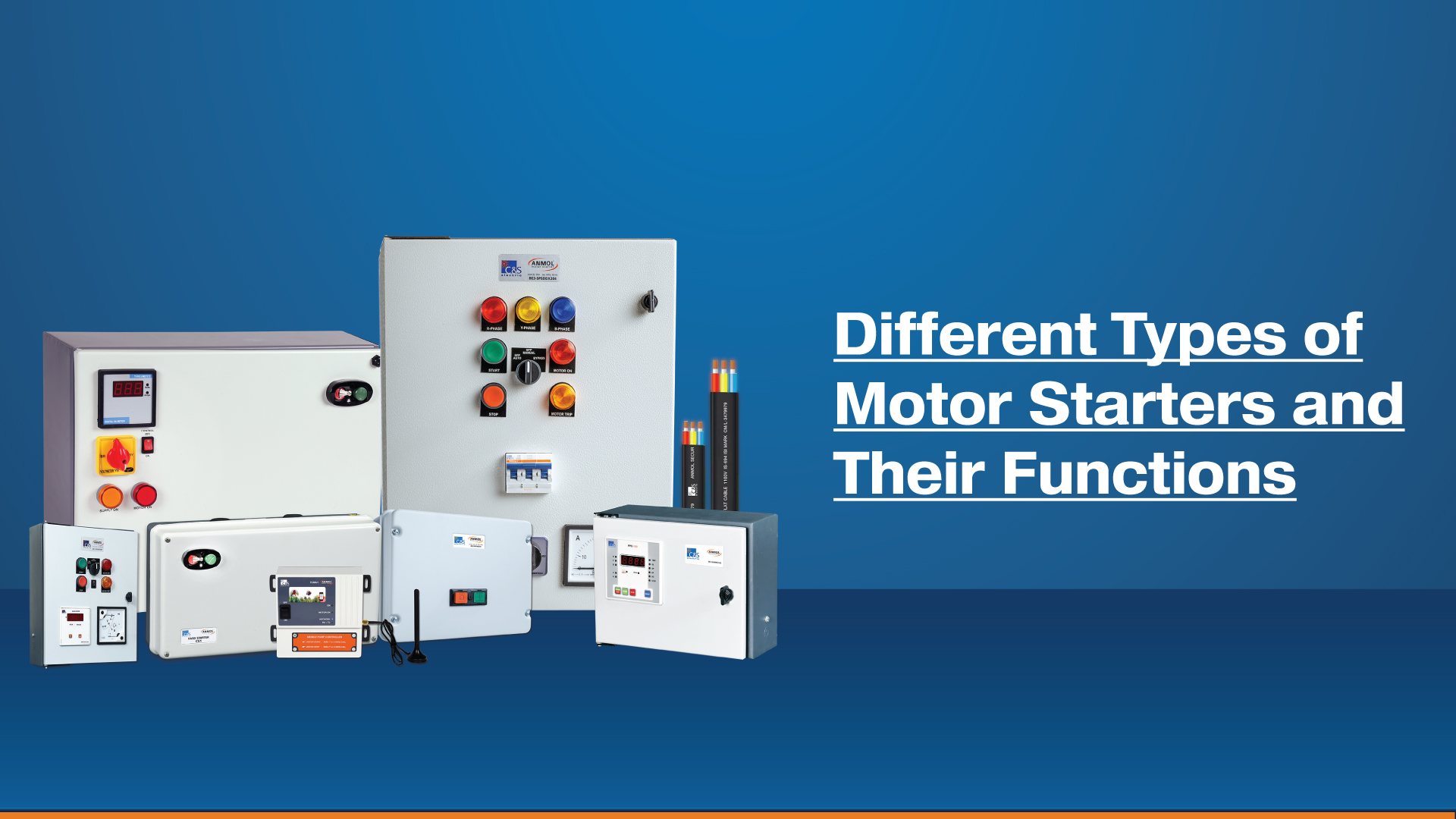
Electric motors are the real workhorses of industry, that transmit power to massive industrial pumps and conveyors also to the large fan in factories. However, simply plugging a motor into the wall is not the best or the safest way to operate it. This is where motor starters come into play – critical devices that not only starts motor operation but also provide essential protection and controlling.
Motor starter works as the motor’s brain and bodyguard. It manages the Inrush current when a motor first gets on, motor starter act as shield and provide protection from harmful electrical faults, control its speed and direction.
What is a Motor Starter? The Core Functions
A motor starter performs several vital functions for an electric motor:
- Connecting/Disconnecting Power: just like a switch, it connects the motor to the power supply and disconnects it when not in use.
- Overload Protection: This is the most critical safety function. When a motor draws too much current (due to mechanical overload, fault, or an issue with the motor itself), the starter detects this and trips, which protects motor from damage
- Short-Circuit Protection: In the event of a severe fault, the starter quickly isolates the motor from the power supply to prevent internal damage.
- Low Voltage Protection: If the supply voltage drops, the starter can disconnect the motor immediately and prevent it from operating inefficiently
- Controlling Inrush Current: When a motor starts, it draws higher current for a short period of time. This “inrush current” can cause voltage sags in the electrical system, and trip circuit breakers. Many starters are designed to mitigate Inrush current.
- Rotation Control: Some starters also allow used for reversing the motor’s direction.
- Speed Control (Advanced Starters): Traditional starters mainly used to switch ON/OFF and protection, more advanced types of starters can also control speed or motor.
Type of starter and their advantages
1. Direct Online (DOL) Starter
The Direct Online (DOL) starter is the very common type of starter. It is used for small to medium-size motors where the high inrush current is ok and does not impact the power supply or load.
How it Works: When the start button is pressed, the DOL starter directly connects the motor to the full supply voltage.
Contactor: An electromagnetic switch that makes and breaks the circuit
Overload Relay: Detects extra current and trips the contactor to protect the motor.
Start/Stop Pushbuttons: Manual control for operating motor.
Enclosure: Housing that protects the internal components of starter.
Advantages:
- Easy to understand, wire, and maintain.
- Low cost as compared to other starters.
- Delivers full voltage, resulting in maximum starting torque.
Disadvantages:
- High Inrush Current: It can cause voltage drop and affect other equipment in the same circuit.
- Jerky Start: The application related to full voltage can cause a jolt to the mechanical system, which can leads to wear and tear over time.
Applications: Small pumps, fans, conveyors, compressors, where the motor rating is low (up to 10kW or 15HP).
2. Star-Delta Starter
The Star-Delta starter is a choice for reducing the high inrush for large induction motors. It is an effective simple method for “reduced voltage starting.”
How it Works: The motor is initially connected in “star” configuration during starting. In this type of connection, the voltage across each motor winding is decreased by factor of √3 (approximately 58% of the line voltage). This will reduce the starting current and torque. After a set period of time the starter automatically switches the motor windings to a “delta” connection, with full line voltage for normal running operation.
Components:
- 3-Contactors: Main, Star, and Delta contactors.
- Overload Relay: For protection.
- Timer: Controls the switching from Star to Delta connection.
Advantages:
- Lowers the inrush current to near 1/3rd of the DOL current.
- Less mechanical stress on the motor and equipment.
- More complex than DOL but less expensive than some advanced methods.
Disadvantages:
- Reduced Starting Torque: the motor struggle to start heavy loads in the Star configuration.
- Current Transients During Transition: A short current surge can occur when switching from Star to Delta.
Applications: Medium to large induction motors (15kW to 200kW) like pumps, fans, compressors, and crushers where a smooth start is required.
3. Auto-Transformer Starter
The Auto-Transformer starter is another low voltage starting method, which is preferred for larger motor.
How it Works: An auto-transformer with multiple taps is used to apply the low voltage to the motor during start. The motor initially receives, for example, 50%, 65%, or 80% of the full line voltage. After the motor speed get increased, a timer or current sensing device switches the motor directly to the full line voltage, and the auto-transformer gets disconnected.
Components:
- Auto-Transformer
- Multiple Contactors: For starting and running the motor.
- Overload Relay: for protection.
- Timer/Control Circuit: for switching.
Advantages:
- Smoother Start.
- Reduce Starting Current and Torque.
- It can be used with both Star and Delta Motors.
Disadvantages:
- Higher Price.
- More complex wiring and components.
- Requires more space due to the transformer.
Applications: Large motors (above 200kW) driving pumps, fans, blowers, and conveyors.
4. Soft Starter
Soft starters is more modern approach for reduced voltage starting. Soft starter use solid-state electronics components to control the voltage.
How it Works: A soft starter continuously varies the voltage applied to the motor from “0 to the full line voltage” for a defined period. This smooth increase in speed is achieved by controlling the firing angle of the thyristors.
Components:
- Silicon Controlled Rectifiers / Thyristors.
- Control Circuitry.
- Bypass Contactor.
- Overload Protection.
Advantages:
- Extremely Smooth Start and Stop.
- Reduced Inrush Current.
- Programmable Parameters.
Disadvantages:
- More expensive than DOL and Star-Delta starters.
- Heat Generation.
- Can introduce some harmonic distortion into the power system.
Applications: Widely used in the application where smooth acceleration is required.
5. Variable Frequency Drive (VFD)
It is mainly known for speed control, Variable Frequency Drives (VFDs) are also the most common type of motor starter. They don’t just reduce starting current; they provide control over motor speed, torque, and direction throughout the entire operation.
How it Works: A VFD converts the incoming AC power to DC, then inverts it back into a variable frequency and variable voltage AC output. By controlling frequency and voltage supplied to the motor, the VFD controls the motor’s speed. During starting, the VFD ramps up both the frequency and voltage from zero.
Components:
- Rectifier: Converts incoming AC to DC.
- DC Bus: Stores the DC power.
- Inverter (IGBTs): Converts DC back to variable frequency/variable voltage AC.
- Control Unit: control the whole process, including motor protection and user interface.
Advantages:
- Non-paralleled Speed Control.
- Very Smooth Start and Stop.
- Advanced Motor Protection.
- Easy reversal of motor rotation.
Disadvantages:
- Most expensive type of motor starter.
- Not easy to install, program, and troubleshoot.
- Generates harmonics into the power system.
Applications: Used for the applications that require perfect speed control, energy efficiency, and extremely gentle starting and stopping. Examples include HVAC systems, large pumps, fans, conveyors, machine tools, cranes, and process where motor speed needs to be varied.
Conclusion: Choosing the Right Starter
The choice of motor starter is not a one-size-fits-all decision. It depends on different factors:
- Motor Size: Smaller motors can tolerate DOL.
- Load Type: Is the load heavy at start? Does it require a smooth start?
- Power Supply Capacity: Can the electrical grid handle high inrush currents?
- Budget: Cost varies between different types of starters.
- Controls: simple ON/OFF is sufficient, or is variable speed required?
- Environmental Concerns: harmonics or EMI related issue?
- Maintenance Requirements: Complexity impacts maintenance.
From the DOL starter to VFD, each type of starter plays an important role to make sure the safe, efficient, and controlled operations of motors. By understanding their different functions and applications, we can make decisions for the selection of starter.
Frequently Asked Questions
Main Types of Motor Starters
The most common type of motor starters used in industries are, Direct-On-Line (DOL), Star-Delta, Soft Starters, and Variable Frequency Drives (VFDs). Every starter is selected on the basis of the specific function or on how much power the motor needs and what type of controls you want for motor. Choosing the right depends on your budget and the mechanical stress your equipment can handle.
A DOL starter is the simplest method; it connects the motor directly to the power supply as soon as you switch on the “start button.” It uses a contactor to switch the power, and an overload relay switch off the starter if the current gets too high. Because it hits the motor with 100% voltage instantly.
You should use a Star-Delta starter when you have a large motor that draws high starting current and trips your breakers if started normally. It starts the motor in a Star connection to get it spinning slowly, then switch it to Delta connection (full power) when it reaches at high speed. That is perfect for pumps or fans that don’t need full torque immediately
A soft starter uses electronics to increase the voltage, that allows the motor to gain the full speed smoothly. This protects the motor by eliminating mechanical shocks and reducing heat from high current spikes. It’s basically acts like a bodyguard for your motor’s internal windings and the mechanical gears of motor.
For heavy-duty application, the Variable Frequency Drive (VFD) is the real king. It is more expensive as compared to other motor starters, although it offers total controls over speed and torque from start to stop.