What is MCCB?
MCCB is a electrical protection device. Its main job is to protect an electrical circuit from damage caused by overload or a short circuit.
Think of it like a high-tech security guard for your electricity. If the current stays within safe limits, the guard lets it pass. If the current gets too high and risks melting wires or causing a fire, the guard slams the door shut instantly. This “shutting the door” is what we call “tripping.”
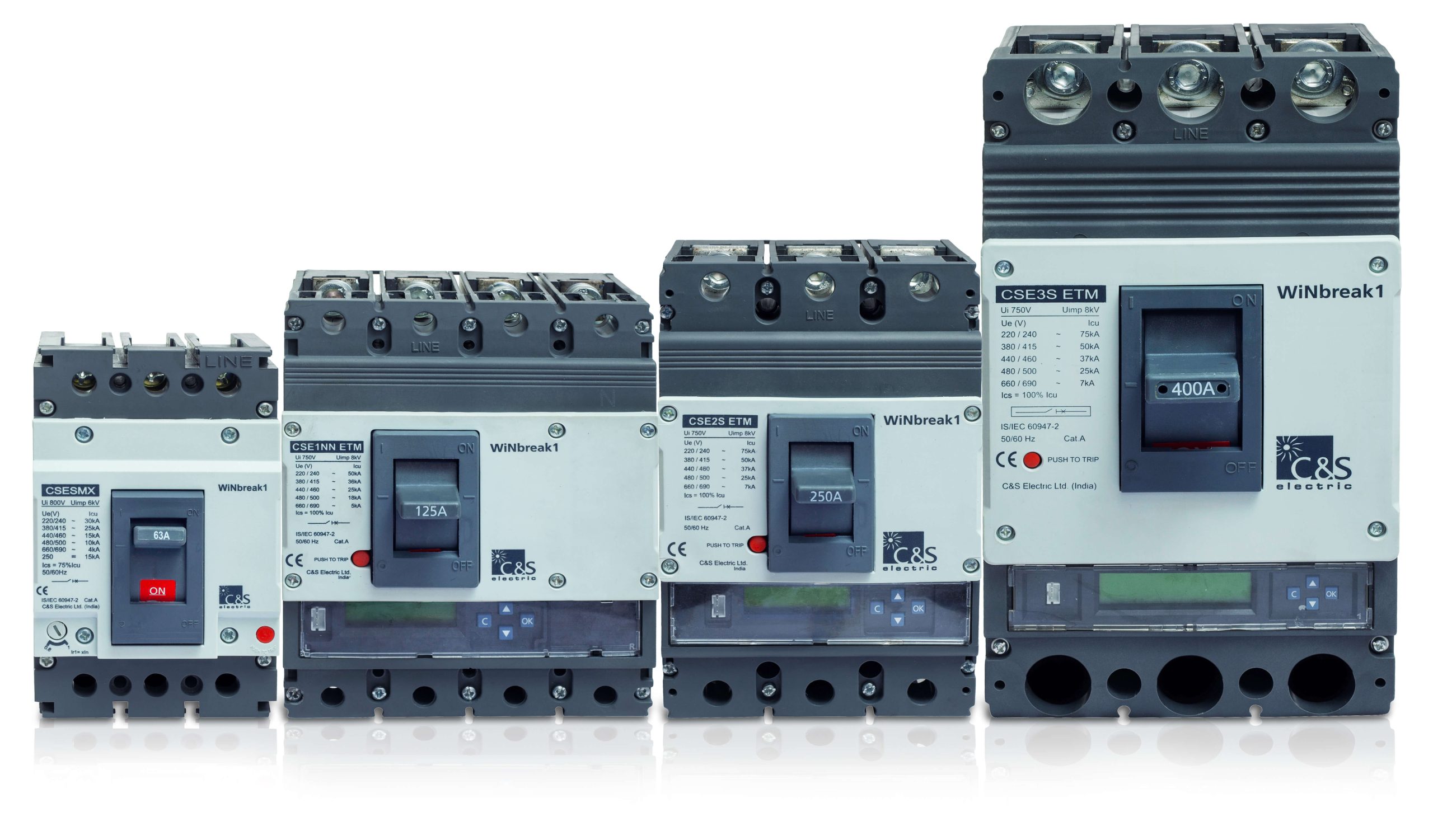
The “Moulded Case” part of the name refers to the fact that the entire internal mechanism is housed in a heavy-duty, hardened plastic or resin shell. This case is incredibly strong, designed to contain the heat and pressure that occurs during an electrical fault.
How an MCCB is Built?
You don’t need an engineering degree to understand what’s going inside an MCCB. While the outside looks like a sturdy box with a switch, the inside is a masterpiece of mechanical safety. Here are the core parts:
- The Moulded Case
As mentioned, this is the outer shell. It provides insulation and protects the internal components from dust, moisture, and curious fingers. Most importantly, it acts as a thermal barrier. - The Operating Mechanism
This is the “brain” of the breaker. It consists of the handle you flip and a series of springs and latches. It ensures that when the breaker trips, it does so quickly and decisively. You’ll notice that when a breaker trips, the handle usually moves to a middle position, signalling that a fault occurred. - The Arc Extinguisher (Arc Chute)
This is arguably the coolest part. When a circuit breaker opens while a heavy current is flowing, a literal “bolt” of electricity (an arc) tries to jump across the gap. This arc is incredibly hot. The Arc Chute is a set of metal plates that breaks that arc into smaller pieces and cools it down instantly, preventing the breaker from exploding. - The Trip Unit
The trip unit is the “sensor.” It tells the breaker when to shut down. Modern MCCBs usually have two types of sensors:
- Thermal Sensor: Uses a bimetallic strip that bends when it gets too hot (overload).
- Magnetic Sensor: Uses an electromagnet that pulls a lever instantly if there’s a massive surge (short circuit).
How Does It Work?
The MCCB operates on two main principles to keep things safe:
The Slow Burn (Thermal Protection)
Imagine you plug in way too many machines at once. The current is higher than the wires can handle, but it’s not an immediate explosion. The wires start to get warm. Inside the MCCB, a metal strip starts to heat up and bend. Once it bends far enough, it hits a trigger, and the breaker trips. This protects the insulation on your wires from melting over time.
The Instant Snap (Magnetic Protection)
Now, imagine a wire snaps and touches a metal frame. This causes a massive, instantaneous spike in electricity. We can’t wait for a metal strip to heat up; we need the power off now. The MCCB uses magnetic force to “yank” the circuit open in milliseconds, long before the heat can cause a fire.
MCCB vs. MCB: What’s the Difference?
This is where most people get confused. They both trip, they both protect, and they both have switches. So, what’s the deal?
Think of it like vehicles. An MCB is like a bicycle or a small car—perfect for neighbourhood streets (your home). An MCCB is like a semi-truck or a freight train—designed for heavy loads and industrial highways.
| Feature | MCB (Miniature) | MCCB (Moulded Case) |
|---|---|---|
| Current Rating | Usually up to 100 or 125 Amps. | Up to 2,500 or 3,200 Amps. |
| Interrupting Capacity | Low (for homes/offices). | Very High (for factories/grids). |
| Adjustable Settings | Usually fixed. You get what you buy. | Often adjustable. You can “tune” the trip settings. |
| Size | Small, fits in a standard home box. | Large, heavy, and robust. |
| Usage | Domestic and light commercial. | Industrial and heavy commercial. |
Key Takeaway: You use an MCB for your lights and wall outlets. You use an MCCB for the main power feed of a building or for heavy machinery like industrial ovens and large motors.
Where Do We Use MCCBs?
Because they can handle such high amounts of power, you’ll find MCCBs in places where electricity is doing the “heavy lifting.”
- Industrial Plants
Factories use massive motors, welders, and conveyor belts. These machines pull a lot of juice. MCCBs are used to protect these individual machines and the main distribution boards that feed them. - Commercial Buildings
Think of a shopping mall or a 50-story office tower. The HVAC system alone (heating and cooling) uses enough power to run a small town. MCCBs manage this load and ensure that a fault in one shop doesn’t shut down the entire mall. - Data Centres
Servers are incredibly sensitive. Data centres use MCCBs to protect their power supplies, ensuring that the “cloud” stays online even if there’s an electrical hiccup. - Renewable Energy
Solar farms and wind turbines generate massive amounts of DC power that gets converted to AC. MCCBs are crucial in these installations to protect the expensive inverters and transformers. - Generators
Large backup generators for hospitals or hotels need a way to connect safely to the building’s grid. MCCBs act as the gatekeeper for that power.
Why Should we Care About “Adjustable Settings”?
One of the biggest advantages of an MCCB over an MCB is that it is adjustable.
In a home, you just want the power to go off if it’s unsafe. But in a factory, you might have a machine that naturally “spikes” its power usage for two seconds when it starts up. If you used a standard breaker, it would trip every time you turned the machine on.
With an MCCB, an electrician can adjust the trip curve. They can tell the breaker, “Hey, it’s okay if the power jumps for 3 seconds, but if it stays high for 5 seconds, shut it down.” This level of customization prevents “nuisance tripping” while still keeping everyone safe.
Summary:
To wrap it up, the Moulded Case Circuit Breaker (MCCB) is the heavy-duty version of the safety switches we use every day. It is built tougher, handles significantly more current, and offers the flexibility that big industries need.
While the MCB handles the small stuff in our kitchens and bedrooms, the MCCB is working behind the scenes in our hospitals, factories, and skyscrapers. It’s a perfect blend of old-school mechanical engineering and modern electrical safety.
Next time you walk past a large Gray electrical cabinet in a basement or a mechanical room, you’ll know exactly what’s inside: a moulded case, an arc-quenching system, and a smart trip unit, all standing guard to make sure the lights stay on—and the building stays safe.