
- 1A/5A Rated CT (Site selectable)
- 50/60Hz Nominal Frequency (Site selectable)
- Draw-out Relay with Self CT shorting modular design
- 4 Analog CT
- Synchro check facility
- User configurable 8 Digital Input / 8 Digital Output *
- 20 Fault & 500 Event records with date and time stamp
- 1200 cycles of Disturbance recording
- IEC 61850-Edition-2 / IEC-103 / MODBUS communication protocol *
- Interactive HMI with USB Plug & Play support
- Wide Range of Aux Supply
- Common configuration Software-Designer suite M12
- Relays are equipped with a self-supervision function
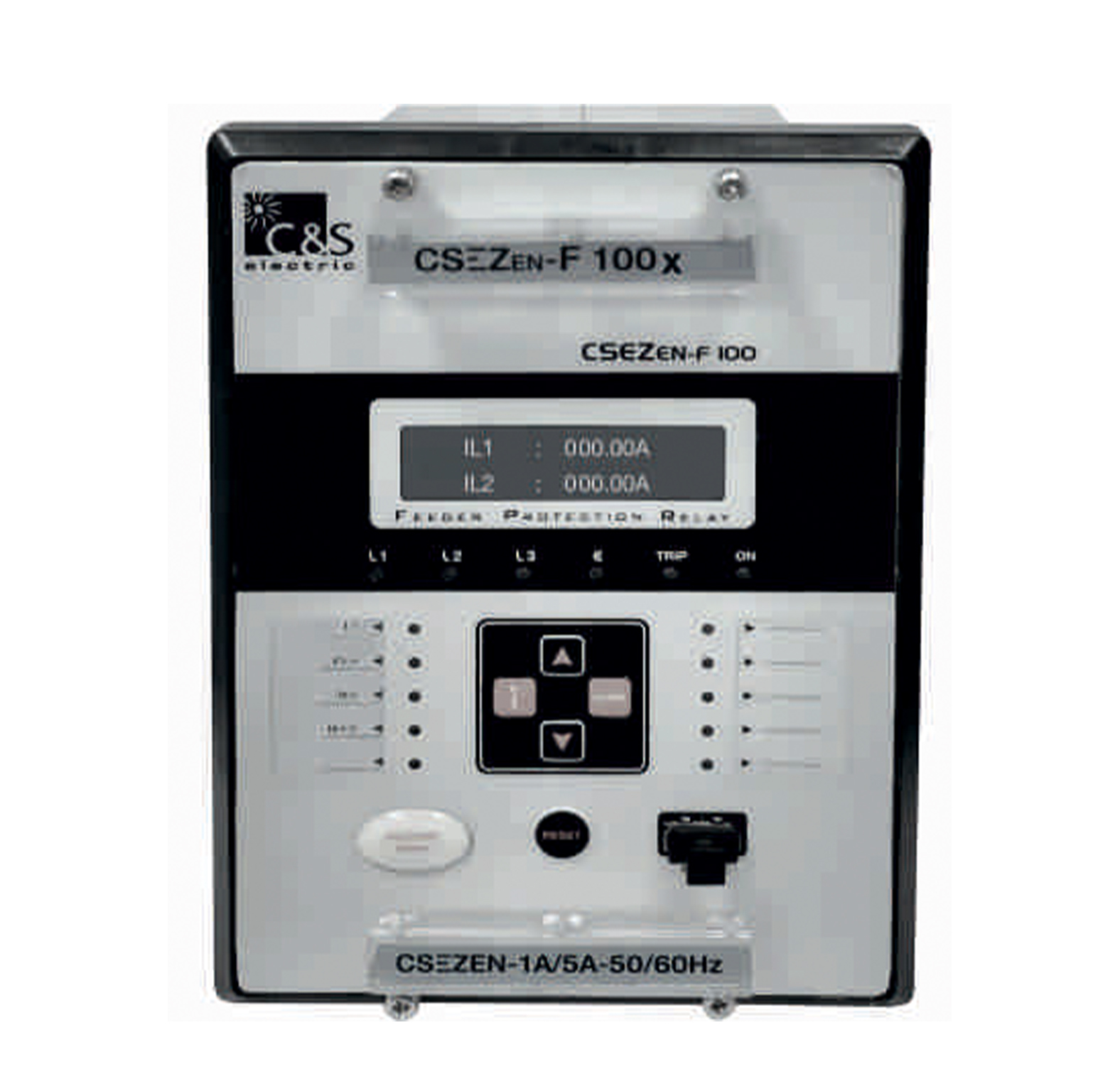
Advance Feeder Protection & Monitoring IED : CSEZEN-F100 & 100x
FEATURES
CSEZEN series offers a multi-functional, comprehensive smart protection solution for Feeder, Generator, Motor & Transformer segment.
CSEZEN family of protective relays are advanced numerical relays that provide multi-protection and monitoring with a reliable and fast protection solution in a single unit.
In this family of CSEZEN series, the CSEZEN-F is an advanced Feeder protection relay designed for controlling, protecting, and monitoring industrial installations, public distribution networks, and substations.
CSEZEN-F also provides an automation solution of power control. It complies with IEC 60870-5-103, IEC 61850, Modbus protocol for high integration of protection & control. CSEZEN-F offers the following features in a compact & smart flush mounting enclosure.
APPLICATION:
CSEZEN-F relay will cover a wide range of protection functions required for the feeder segment. It can be used as part of a protection scheme for transformers and generator transformers. CSEZEN-F relays can also provide back-up protection for HV and EHV transmission systems.
Feeder protection relays are critical components in electrical power systems, offering several key benefits that ensure the safety, reliability, and efficiency of the power distribution network.
- Enhanced System Reliability and Stability.
- Minimization of Equipment Protection and Damage: Relays detect and initiate the isolation of faults (like short circuits, overloads, and earth faults).
- Extended Asset Lifespan: By protecting equipment from damaging fault currents and overloads
- Improved Personnel Safety: The risk of electrical hazards such as fire, electric shock, and arc flashes is significantly reduced, ensuring the safety of utility personnel and the public.
- Operational Efficiency and Maintenance.
- Reduced Downtime and Quick Restoration.
- Real-time diagnostics and Monitoring by Modern, microprocessor-based relays.